Adult Survivors of Child Abuse - Cowra support group:
another option to help you heal from childhood trauma.
another option to help you heal from childhood trauma.
About the Support Group
Introducing the support group
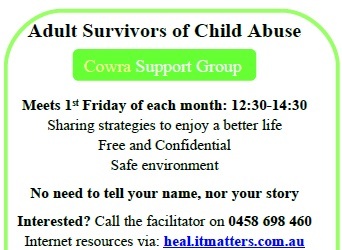
- The Adult Survivors of Child Abuse - Cowra Support Group was formed early 2011
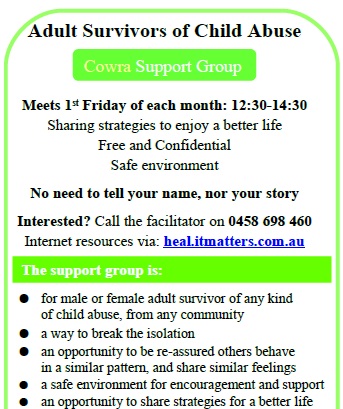
- to assist survivors of any form of child abuse / childhood trauma
- as well as assist their family and friends
- to find and share options to heal.
What is the support group about?
- The support group does not seek to replace counselling nor is it about counselling.
- The group is about sharing ways of handling the challenges of daily life which may help someone else to improve their own life.
- The support group provides information on resources: books, organisations, helplines, websites, articles, strategies, peer support, workshops, and access to professional counselling.
- The group respects your privacy: There is no need to disclose your name. There is no need to tell your story.
When does the support group meet?
- The group meets every month on the 1st Friday of each month from 12:30 to 14:30.
- Each meeting is held in a safe environment in Cowra, NSW.
How is the support group run?
- Prior to each meeting you receive via email (if you have one) a reminder including a newsletter with items discussed in prior meetings (in general terms and without disclosing names nor stories), upcoming workshops, books, or articles focused on healing.
- Each meeting is based on sharing and supporting each other so that each one of us can better handle the challenges of daily life and enjoy a better life.
- During each meeting we welcome new members, remind each other of our group agreement including amending or adding to it if need be, discuss how we have been, and start sharing strategies or hints which may help one another.
- You may take a break from the meeting at anytime.
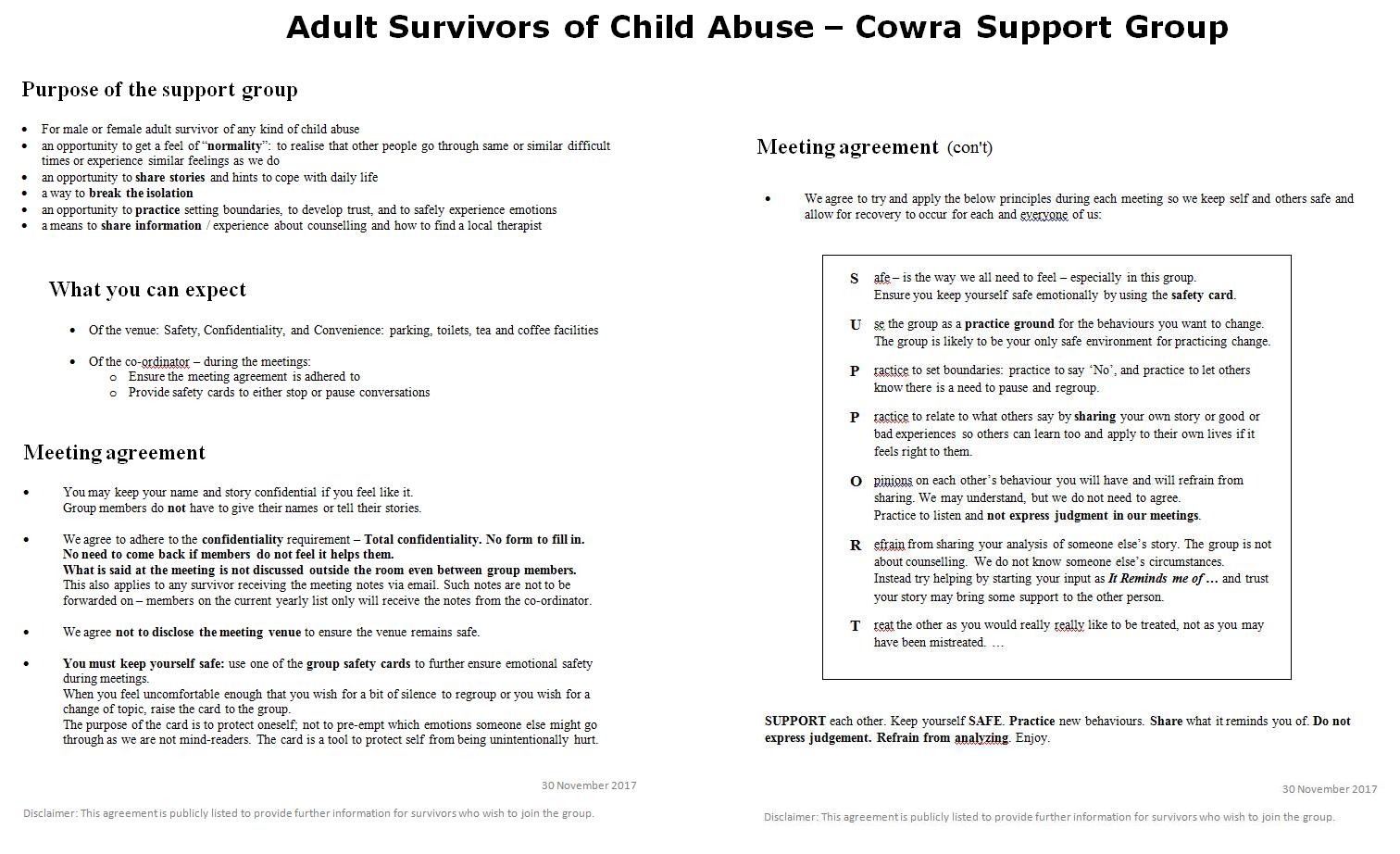
read our meeting agreement
read our responsibilities
browse our group resources
What if you are interested to join?
- It is better for you and for the smooth and safe running of the group meetings that you fully understand the group's objectives.
- Call Pascale, the facilitator, on 0458 698 460, have a chat, and assess whether this group is what you are looking for.
- You will also be given the opportunity to meet one or more group members prior to attending your first meeting.
- This will make your first attendance within our welcoming group, a safe and enriching experience.
Access resources
All the resources are provided to you courtesy of the Cowra support group. They may or may not help you. Consider carefully. In doubt consult your therapist.
All the resources are provided to you courtesy of the Cowra support group. They may or may not help you. Consider carefully. In doubt consult your therapist.
Publications: books, articles, etc...
- Popular titles:
- The Courage to Heal, Ellen Bass, Laura Davis. (For female survivors of sexual abuse)
- Victims no longer, Mike Lew. (For male survivors of sexual abuse)
- The Silent Crisis, Amanda Robinson. (Focuses on prevention - advice for parents)
- Article from the Blue Knot Foundation - Finding a trauma-informed therapist (2024) Fact Sheet on the BlueKnot website
access Resources from the healing page
- For activities including calming the nervous system
- For the list of Health Professionals / Therapies / Retreats / Workshops
- For the list of Organisations
- For the list of Publications
from our meetings
- Pattern of behaviour: this is a list of behaviours or observations which the support group discusses on a regular basis and which therefore seems to fall in a category of pattern or behaviours which most survivors may adopt. Note that this does not mean ALL survivors experience ALL such behaviours. This list may be helpful when trying to change your behaviour and improve your daily life.
- Hints: these are strategies shared by attendees of the support group over time.